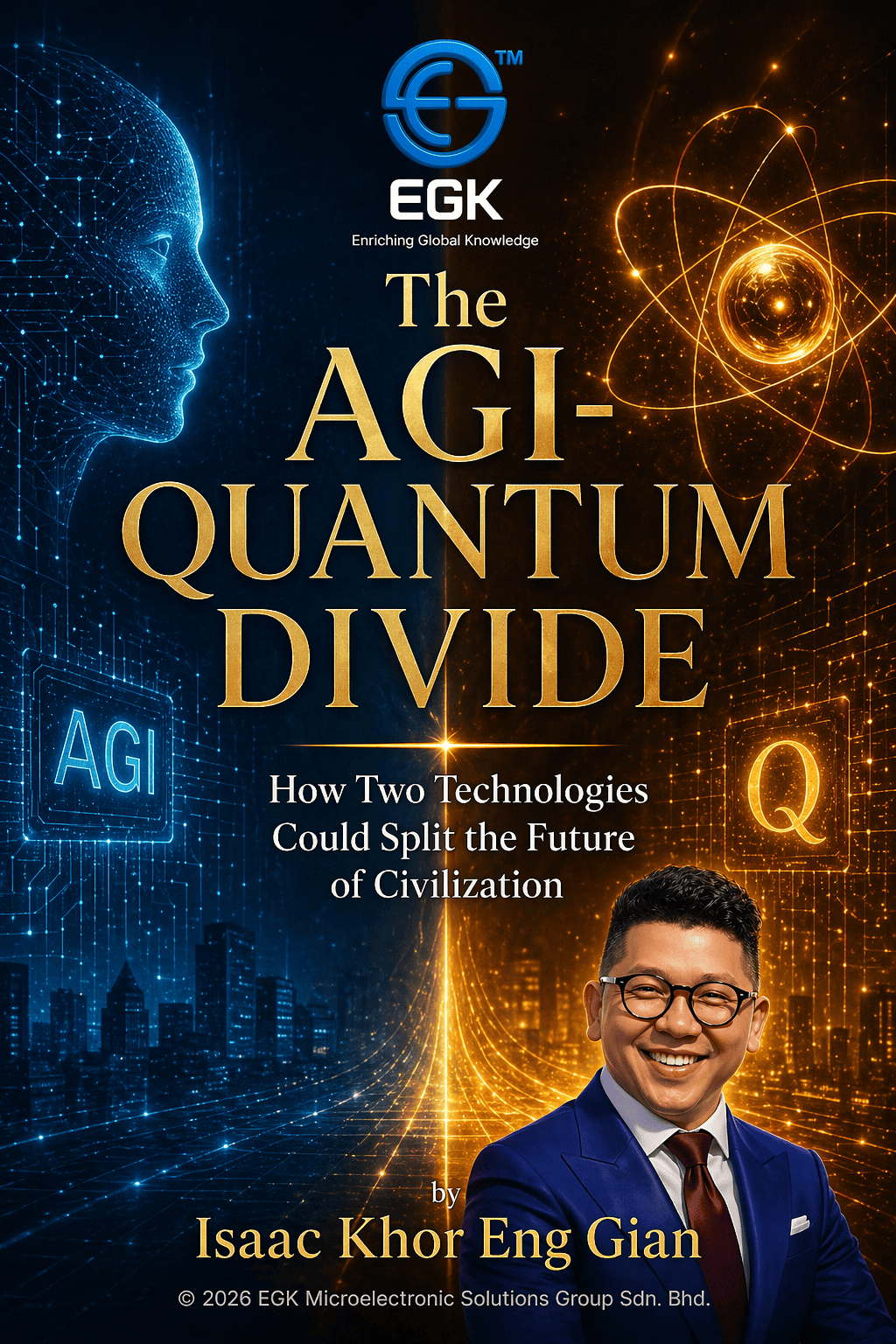
THE AGI–
QUANTUM
DIVIDE
How Two Technologies Could Split
the Future of Civilization


Title
The AGI-Quantum Divide: How Two Technologies Could Split the Future of Civilization
Author
Isaac Khor Eng Gian
Author & Founder, EGK Microelectronic Solutions Group Sdn. Bhd.
Publisher
EGK Microelectronic Solutions Group Sdn. Bhd.
8, Lintang Beringin 8, Diamond Valley Industrial Park,
11960 Batu Maung, Penang, Malaysia
Tel: +604-505-9700 · Website: www.egkhor.com.my
Email: sales@egkhor.com.my
First Published
2026 (First Edition)
ISBN
978-629-94949-4-2
Format
Digital (HTML5 Interactive Edition) · Print-Ready PDF Edition
Copyright / Hak Cipta
© 2026 EGK Microelectronic Solutions Group Sdn. Bhd.
No part of this publication may be reproduced, stored in a retrieval system, or transmitted in any form or by any means — electronic, mechanical, photocopying, recording, or otherwise — without prior written permission from the publisher, except for brief quotations in reviews or academic citation permitted under applicable copyright law.
The views expressed in this work are those of the author and do not constitute professional legal, financial, or technical advice. All scenario analyses are interpretative frameworks and should not be treated as factual predictions.
References to artificial intelligence and quantum computing developments — including NVIDIA’s Ising announcement (April 2026) and related industry advances — are included for analytical and educational context. All trademarks remain the property of their respective owners and are used for identification purposes only.

The AGI-Quantum Divide: How Two Technologies Could Split the Future of Civilization / Isaac Khor Eng Gian
Penang: EGK Microelectronic Solutions Group Sdn. Bhd., 2026
ISBN 978-629-94949-4-2
1. Artificial intelligence.
2. Quantum computing.
3. Technology and society.
4. Future studies.
I. Title.
and for the students who will inherit both the promise and the weight
of what we are building together. And for Mushi and Aida —
two characters born from code, carrying a mission.
Contents
- A Note Before We Begin1
- The Convergence Nobody Planned5
- Chapter 1 — The Wall at the End of Moore's Law13
- Chapter 2 — Why Today's AI Cannot Think27
- Chapter 3 — The Noise Problem: Quantum's Unsolved Childhood41
- Chapter 4 — What Hybrid AI Acceleration Changes55
- Chapter 5 — Quantum Without a Guide71
- Chapter 6 — The Governments Take the Atom85
- Chapter 7 — Medicine at the Speed of Committees99
- Chapter 8 — The Widening Chasm113
- Chapter 9 — Autonomous Labs129
- Chapter 10 — The Day Human Scientists Become Optional143
- Chapter 11 — AGI Discovers New Physics159
- Chapter 12 — Infrastructure Without Operators173
- Chapter 13 — The Employment Earthquake187
- Chapter 14 — The Compressed Revolution205
- Chapter 15 — When the Encryption Breaks219
- Chapter 16 — The Darker Convergence233
- Chapter 17 — Who Controls the Future?249
- Chapter 18 — The Great Stagnation250
- Epilogue — The Necessity Question267
- About the Author275
- EGK Publishing House — Other Titles277
A Note Before We Begin
In April 2026, Jensen Huang stood before an audience and described a future that, eighteen months earlier, would have read like speculative fiction. NVIDIA’s announcement of NVIDIA Ising wasn’t just another product release. It was a signal.
It signaled that artificial intelligence was no longer being built merely to serve humans. It was now being designed to stabilize, calibrate, and accelerate another frontier technology powerful enough to reshape civilization itself: quantum computing.
I had been writing about this convergence before the announcement arrived. My earlier work, Hybrid AI Acceleration (eISBN 978-629-94581-7-3), first published in December 2025, explored these themes—not because I had access to insider knowledge, but because the trajectory was already visible to anyone willing to examine both streams simultaneously: the artificial intelligence race accelerating on one track, and the fragile, noisy, brilliant promise of quantum computing struggling toward reliability on another.
This book is not a prediction. Predictions age badly. What this book offers instead is a set of carefully constructed scenarios — analytical frameworks for thinking about a divide that may determine more about the shape of human civilization than any decision made in the next decade by any government, company, or individual acting alone.
The title, The AGI-Quantum Divide, refers to something more than the gap between two technologies. It refers to the civilizational split that emerges when you trace the consequences of two possible futures: one in which Artificial General Intelligence arrives and transforms everything it touches, including quantum computing itself; and one in which it doesn't, leaving humanity to navigate a quantum age with the same narrow, limited AI tools we have today.
My background is in semiconductor engineering, ESD protection systems, and the architecture of AI acceleration frameworks. That grounding matters here. I write not as a futurist speculating from abstraction, but as someone who works daily in the space where silicon meets software, where hardware constraints shape what algorithms can actually do. The limitations I describe are not rhetorical. They are engineering realities I encounter in practice.
What I hope you take from this book is not certainty. There is very little certainty available. What I hope you take is the capacity to reason carefully about which future you are inhabiting — and which decisions, made now, might influence which one arrives.
Penang, Malaysia
April 2026
The World as It Actually Is
"Before we can understand where two rivers might meet, we must first understand
why both of them are still fighting their own currents."
The World as It Actually Is
"Before we can understand where two rivers might meet, we must first understand
why both of them are still fighting their own currents."
Chapter 1
The Wall at the End of Moore's Law
On the 19th of April, 1965, Gordon Moore published a paper in Electronics Magazine that contained, almost as a footnote, an observation that would quietly govern the shape of civilisation for the next six decades.
Moore noticed that the number of transistors on a chip had roughly doubled each year since the first integrated circuit was produced. He predicted this trend would continue. He was right — for fifty years. And the entire architecture of the modern world was built on that reliability. Every smartphone in your pocket. Every cloud server processing your search. Every autonomous vehicle parsing its environment in real time. All of it is downstream of Moore's Law behaving as promised.
What nobody fully prepared for was the day it stopped.
That day did not arrive with a press release. It arrived quietly, in the semiconductor fabs of TSMC, Samsung, and Intel, as engineers discovered that moving to the next node — the next generation of miniaturisation — was consuming an exponentially growing share of research budget for an exponentially shrinking return. The gains were still real. But they were no longer the gains of a covenant. They were the gains of a civilisation reaching the bottom of a barrel it had not previously known was finite.
The Physics of an Ending
Here is the engineering reality that most technology commentary never quite captures: the transistors being built at the frontier of semiconductor fabrication are no longer reliably classical objects. At 2 nanometres — the current bleeding edge, the node at which TSMC is now shipping production chips — engineers are working at the scale of ten silicon atoms placed side by side. A human hair is roughly 80,000 nanometres wide. The features being carved into silicon today are objects that exist at the boundary between classical and quantum mechanics.
At this scale, electrons do not behave the way they do in introductory physics textbooks. Quantum tunnelling — the phenomenon in which a particle passes through a barrier it classically should not be able to penetrate — becomes not an exotic edge case but a dominant engineering constraint. Electrons begin leaking through gate oxides, through insulators, through barriers designed to control them. The transistor, which is fundamentally a switch — a controlled gate that allows or blocks current — begins to blur. The off state is not fully off. The on state is not reliably on.
At sub-2nm nodes, leakage current — electrons tunnelling through gate oxides — becomes a dominant energy loss mechanism. The very quantum effects that make quantum computing possible actively undermine classical computing at its smallest scales. This is not a software problem. No optimisation of code architecture can overcome a hardware limit rooted in physics.
The industry has responded with increasingly baroque engineering solutions. Gate-all-around transistors wrap the gate material around the channel on all sides, improving electrostatic control. Three-dimensional stacking layers chips vertically to improve memory bandwidth without requiring further planar shrinkage. Chiplets — disaggregated chip designs that package multiple dies in a single package — allow continued performance scaling without requiring every functional block to shrink simultaneously.
These are not failures of imagination. They are the products of extraordinary engineering talent working at the absolute limit of what physics permits. But they are also, unmistakably, workarounds. The elegant covenant of Moore's Law — print smaller, get faster, get cheaper — has been replaced by a complex negotiation between materials science, thermal management, packaging innovation, and economic viability. The era of free improvements is over.
The Energy Wall
There is a second constraint that the public conversation around AI performance rarely addresses adequately: power consumption. Training a large language model of the GPT-4 class requires on the order of tens of gigawatt-hours of electricity — roughly the annual consumption of a small town. The frontier models being trained in 2025 and 2026 are substantially larger. Data centre power consumption globally is growing at rates that grid infrastructure was not designed to accommodate.
Global data centre power demand (2023): ~240–340 TWh per year — approximately 1% of global electricity consumption.
Projected demand (2026): Analysts project 3–4% of global electricity consumption as AI workloads scale.
Training a large frontier model: Estimated 50–100+ GWh per training run for the largest models, comparable to powering a small city for a month.
Nuclear energy resurgence: Microsoft, Google, and Amazon have all signed agreements to power data centres from nuclear sources — a direct response to the computational energy crisis.
Sources: International Energy Agency (IEA), Goldman Sachs Power & Utilities Research 2024. Figures represent order-of-magnitude estimates; precise consumption figures are not publicly disclosed by model developers.
This energy constraint is not merely an environmental concern, though it is that. It is also a competitive and strategic constraint. The countries and corporations that can secure low-cost, reliable, high-density power for computational infrastructure will have structural advantages in the AI race. This is already reshaping where data centres are built, which energy companies are valued most highly, and which nations are positioning themselves for computational relevance in the coming decade.
The Parallelism Detour
When individual transistors could no longer be made faster, the industry made a decision so pragmatic and so consequential that its full implications are still unfolding: instead of making chips faster, make them wider. Put more processing units side by side. Let them work simultaneously. This is parallelism, and for the better part of the last fifteen years, it has been the engine powering everything you associate with modern computing performance.
The graphics processing unit tells this story most clearly. The GPU was designed for a narrow problem: rendering the pixels of a video game frame in real time, a task that requires performing the same mathematical operation — transform, light, shade — on millions of independent pixels simultaneously. For this problem, massive parallelism is ideal. A GPU is, architecturally, a device that does many things at once rather than one thing very fast.
The insight that transformed the AI industry — the insight that was, in retrospect, the founding insight of the NVIDIA that now dominates global technology markets — was that training neural networks looks, mathematically, remarkably like rendering graphics. Both are dominated by matrix multiplications: operations that multiply enormous arrays of numbers together. The GPU, built to render Halo, turned out to be nearly ideal for training the systems that would power ChatGPT.
NVIDIA's transformation from a gaming peripherals company to the central infrastructure provider for the most strategically important technology in human history is perhaps the defining corporate story of the 2020s. In 2019, NVIDIA's market capitalisation was roughly $100 billion. By mid-2024, it had crossed $3 trillion, briefly making it the most valuable company in the world. This was not a coincidence of timing. It was the direct consequence of the parallelism strategy reaching full industrial deployment.
But parallelism, too, has limits. Energy consumption scales with core count. A data centre running ten thousand GPUs consumes ten thousand times the power of one. Heat dissipation becomes a physical engineering problem of the first order. And certain classes of problems — the problems that matter most for science, for medicine, for optimisation of truly complex systems — do not parallelise cleanly. They require something fundamentally different.
What Quantum Promises
Classical computers work with bits — discrete units of information that are either zero or one, off or on, the fundamental binary logic of all classical computation. Quantum computers work with qubits: quantum mechanical systems that can exist in superposition — effectively in multiple states simultaneously — until they are measured. The distinction is not merely technical. It is a different relationship between information and reality itself.
Consider a maze. A classical computer solves a maze the way a human does: it tries one path, hits a dead end, backtracks, tries another. Even a very fast classical computer is doing this sequentially, or in parallel — running multiple paths simultaneously on separate cores. A quantum computer, exploiting superposition and entanglement, can, for certain problem structures, explore all paths simultaneously and arrive at the solution through quantum interference — constructive interference amplifying the correct answer, destructive interference cancelling the wrong ones.
The theoretical implications are staggering. A quantum computer with 300 qubits in superposition can represent more simultaneous states than there are atoms in the observable universe. For certain classes of problems — factoring large numbers, simulating molecular interactions, optimising complex logistics networks — this offers computational advantages that no amount of classical hardware can ever replicate, regardless of how many chips you stack or how much electricity you supply.
Shor's Algorithm: Factoring large integers exponentially faster than classical methods. Directly threatens RSA encryption — the mathematical foundation of modern internet security. A sufficiently large quantum computer running Shor's Algorithm could break 2048-bit RSA encryption in hours; classical computers would require longer than the age of the universe.
Grover's Algorithm: Searching unsorted databases with quadratic speedup. Reduces the effective security of symmetric encryption by half — meaning AES-128 becomes effectively AES-64 against a quantum adversary.
Quantum Simulation: Simulating molecular and quantum mechanical systems with exponential efficiency. This is potentially the most important near-term application: drug discovery, materials science, catalyst design, and battery chemistry all involve quantum mechanical interactions that classical computers can only approximate.
Quantum Annealing / Ising Machines: are computational approaches that map complex optimization problems onto spin systems, where solutions emerge as minimum-energy (ground state) configurations of an Ising Hamiltonian. These methods are actively studied as potential tools for combinatorial optimization problems.
In April 2026, NVIDIA’s Ising announcement reframed this space—not as standalone optimization hardware, but as part of a broader AI-driven control layer for quantum systems. Rather than delivering quantum advantage directly, the focus is on accelerating two bottlenecks that determine whether such advantage becomes achievable at scale: quantum calibration and error correction.
The promise is extraordinary. The practical reality, as of 2026, is that this promise remains largely theoretical — not because the physics is wrong, but because building a quantum computer that is large enough, stable enough, and accurate enough to demonstrate meaningful advantage over classical systems is an engineering challenge of breathtaking difficulty that has consumed decades of effort from some of the most talented physicists and engineers on Earth.
That challenge is the subject of Chapter 3. But first, we need to understand the intelligence — or rather, the intelligent-seeming systems — that many believe will ultimately solve it.
🔒 Continue Reading
You’ve reached the end of the free preview.
The full book explores:
- Why today's AI cannot truly think
- The quantum noise problem
- Hybrid AI acceleration
- The AGI–Quantum convergence
Other Titles by Isaac Khor
18 published titles spanning Finance, AI Engineering, STEM Education, Character Education & Humanitarian themes
ISBN 978-629-94581-0-4
ISBN 978-629-94581-1-1
ISBN 978-629-94581-2-8
ISBN 978-629-94581-3-5

ISBN 978-629-94581-4-2
ISBN 978-629-94581-5-9

ISBN 978-629-94581-8-0
ISBN 978-629-94581-6-6
ISBN 978-629-94581-7-3

ISBN 978-629-94581-9-7
ISBN 978-629-94949-0-4
ISBN 978-629-94949-1-1
eISBN 978-629-94949-2-8
ISBN 978-629-94949-3-5
EISBN 978-629-94949-4-2
ISBN 978-629-94949-5-9
ISBN 978-629-94949-4-2
ISBN 978-629-94949-6-6
What happens when two of the most transformative technologies in human history arrive in the wrong order — or together — or not at all? The AGI-Quantum Divide is an unflinching scenario analysis by Isaac Khor, written from the perspective of a semiconductor engineer who works daily at the intersection of hardware, AI, and computational limits.
Structured across four parts, the book examines the present limitations of classical computing and current AI, then constructs two divergent futures: one in which AGI never arrives and quantum computing matures slowly under government control; and one in which AGI transforms quantum research, compresses the innovation timeline, and raises civilisational questions that governance frameworks are not designed to answer.
Neither utopian nor apocalyptic, this is a book written for builders and thinkers — for anyone who wants to reason clearly about the most consequential fork in the road that humanity has ever faced.