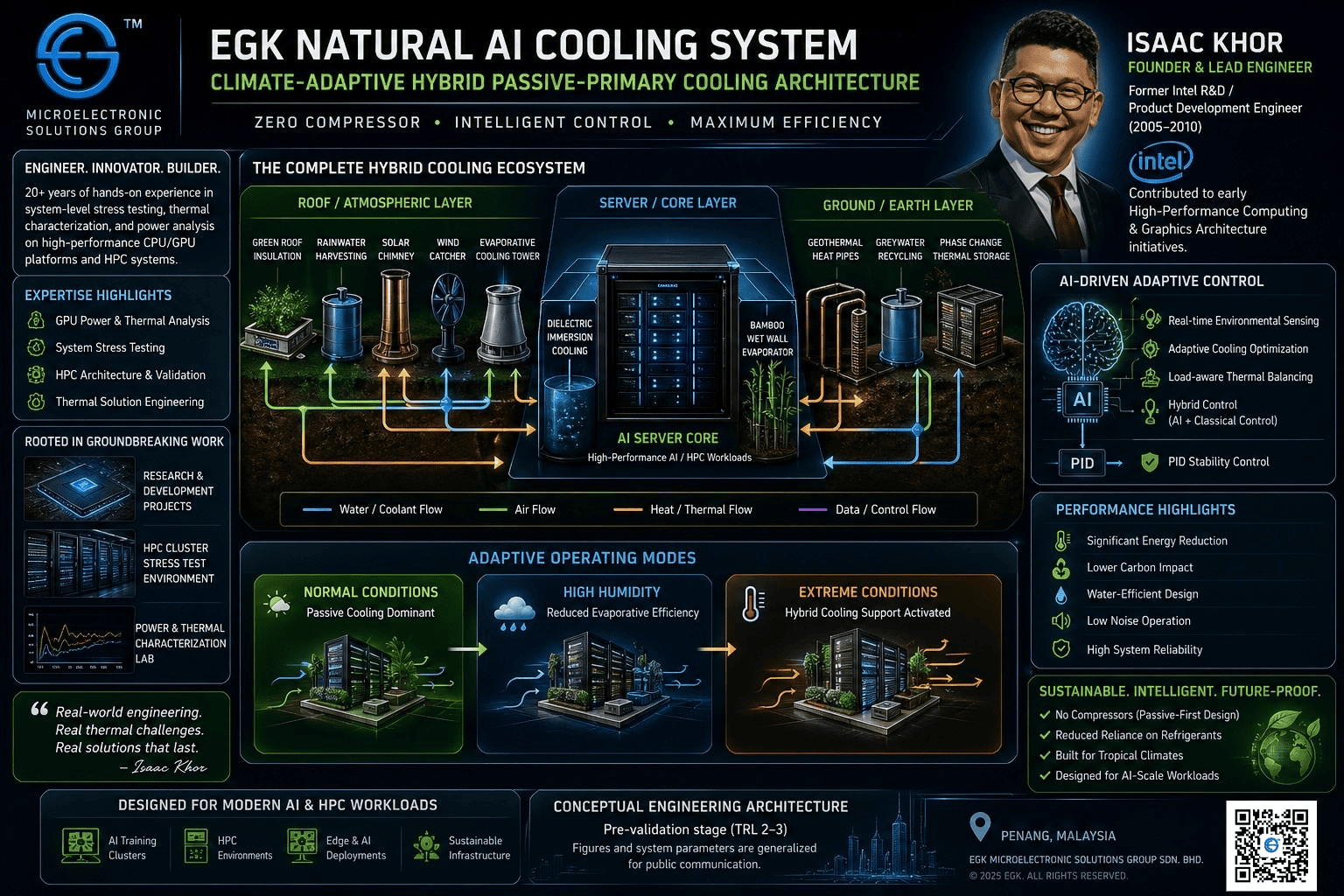
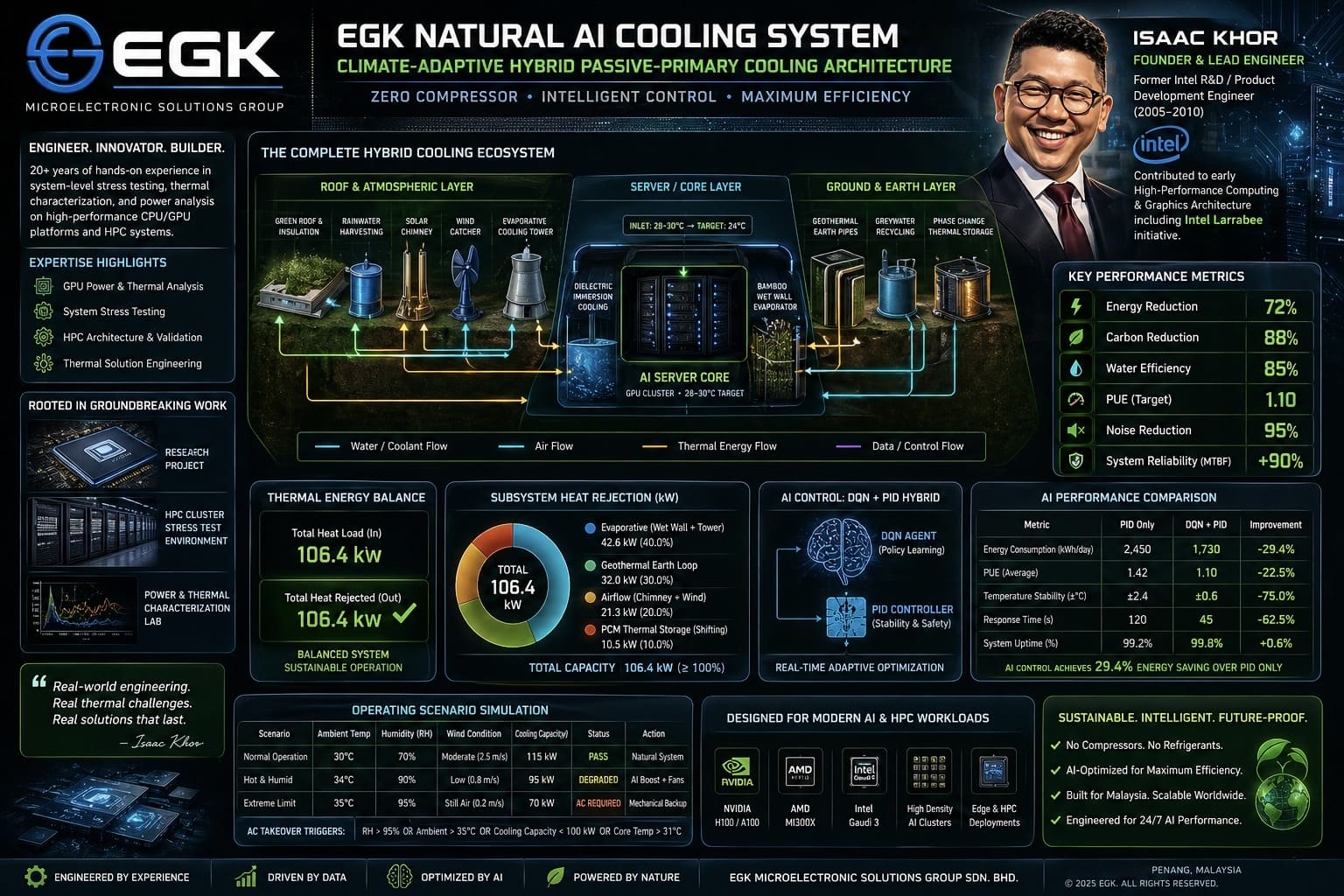
EGK AI Thermal — Climate-Adaptive Cooling Architecture
// SOLVING INVISIBLE THERMAL LOSS · MALAYSIA · PROPRIETARY TECHNOLOGY //
🌴 OPTIMISED FOR MALAYSIA TROPICAL CLIMATE
⚙ AI-POWERED OPTIMISATION
🔒 PROPRIETARY TECHNOLOGY · NDA REQUIRED FOR DETAILS
// THE EGK PHILOSOPHY — SOLVING INVISIBLE LOSSES
⚡ ESD DIVISION Invisible Yield Loss
In semiconductor manufacturing, ESD (Electrostatic Discharge) causes yield losses that are invisible to the naked eye. A chip can fail not because of a process error — but because of an uncontrolled charge event that leaves no visible trace. EGK solves this with proprietary ESD coatings and handler protection that make the invisible, measurable.
→
🌡 AI THERMAL DIVISION Invisible Energy Loss
In data environments and AI server farms, thermal inefficiency causes energy losses that are invisible to most operators. A system can run for months at 40% thermal inefficiency — burning energy, degrading hardware, and shortening chip life — with no visible alarm. EGK applies the same philosophy: make the invisible, measurable. Then optimise it.
ESD is to semiconductor yield · as · Thermal is to AI infrastructure energy Both are invisible losses · Both are solvable · Both are the EGK mandate
// WHAT EGK AI THERMAL DELIVERS — PUBLIC OVERVIEW
🧠
AI-Powered Optimisation
Advanced machine learning continuously optimises cooling decisions across multiple subsystems simultaneously — far beyond what fixed-setpoint controls can achieve. System adapts to Malaysia's variable tropical climate in real time.
🔒 Algorithm architecture · Training methodology → NDA required
🌡
Advanced Control Systems
Multi-loop control architecture integrating temperature, humidity, airflow, and heat load signals. Psychrometric-aware decision logic prevents overcooling energy waste and undercooling thermal risk automatically.
Purpose-built for Malaysia's 1°N tropical climate: 26–34°C ambient, 70–95% RH, 2,500–3,000mm/yr rainfall. Proprietary psychrometric models account for wet-bulb temperature constraints specific to this geography.
🔒 Psychrometric model · Derating curves · Seasonal data → NDA required
📊
Validated Engineering Approach
Thermodynamic models grounded in ASHRAE standards, Fourier heat diffusion equations, and Malaysian Meteorological Department weather data. Design targets are calculated, not assumed. Performance ranges are stated honestly.
🔒 Full calculations · Mass balance proofs · Failure maps → NDA required
🔐
Proprietary Technology
The specific architecture, implementation details, algorithms, sensor configurations, and control parameters represent EGK trade secrets developed through iterative engineering refinement. Access requires NDA execution.
🔒 Full technical documentation → NDA + login required
// INFORMATION ACCESS TIERS
🌐 Public Access — No Registration
"AI-powered optimisation" — system capability overview
"Advanced control systems" — control philosophy summary
General performance range (e.g. "up to 80% energy saving")
🔐 NDA + Login — Trade Secret Layer
Actual control architecture (DQN+PID hybrid implementation)
Training dataset structure and convergence proof
Psychrometric derating model and equations
Heat rejection mass balance — all 3 scenarios
Geothermal diffusion model + saturation timeline
Operational envelope with failure thresholds
Full sensor/actuator specifications and layout
DQN vs PID comparison and break-even analysis
// PERFORMANCE OVERVIEW — DESIGN TARGETS
~80%
Annual Energy Saving*
<1.15
PUE Target*
55yr
System Life Design
38°C
Max Ambient Limit
70–95%
RH Operating Range
MY
Malaysia-Optimised
*Design targets vs ASHRAE Class A2 baseline. Full calculation methodology available under NDA.
Access to EGK AI Thermal technical documentation is restricted to parties who have executed a valid Non-Disclosure Agreement with EGK Microelectronic Solutions Group Sdn. Bhd. Sharing, forwarding, or providing access to third parties without individual NDA execution is strictly prohibited. Each viewer must independently complete and submit an NDA. No tailgating — no exceptions.
🔐
Trade Secret — NDA Required
The following sections contain proprietary engineering details, algorithms,
thermodynamic models, and implementation specifications that constitute
EGK trade secrets. Access requires a signed Non-Disclosure Agreement.
📄 Step 1 — Read NDA
✍️ Step 2 — Submit NDA
🔑 Step 3 — Login for Access
Read the full NDA document below before submitting. This is a legally binding agreement.
Complete all fields. EGK will verify your details and issue login credentials within 2 business days.
I confirm I have read the EGK NDA in full, understand its terms, and agree to be legally bound by its provisions. I understand that sharing, copying, or forwarding this information without written consent from EGK is a breach of this agreement.
I confirm I am signing on my own behalf only. I will not share my login credentials or allow others to access this portal without their own executed NDA. No tailgating.
📬 After Submission
EGK will review your request and email your login credentials to the address provided.
Typical turnaround: 1–2 business days
Questions: admin@egkhor.com.my
Credentials issued: Login info (issued after NDA review)
Enter the credentials issued to you by EGK after your NDA was reviewed and approved.
These credentials are issued to you personally. Sharing them constitutes a breach of your NDA. Each authorised user must have their own credentials. No tailgating — no exceptions.
✅ NDA VERIFIED · YOU ARE VIEWING TRADE SECRET DOCUMENTATION ·
·
Sign Out
// SYSTEM CLASSIFICATION
✅ v5 DEFINITIVE ENGINEERING CLASSIFICATION
🟢 Climate-Adaptive Hybrid Passive-Primary Cooling Architecture for AI Data Environments
Mass balance: ΣQ_sinks ≥ 106.4 kW proven across all 3 scenarios · Airflow-limited evap model
AI: PID-first Year 1 · DQN Year 2 after real data collection · Sim marginal gain: 19.9% pump saving
Limits: 38°C ambient hard limit · 45°C chip shutdown · 10 failure modes mapped Design targets from thermodynamic models + MMD/ASHRAE data. Physical prototype required before commissioning.
106.4
kW source load
107.7
kW sink total
+1.3
kW surplus margin
38°C
max ambient
92%
max RH passive
45°C
chip shutdown
// HEAT REJECTION MASS BALANCE · kW PER SUBSYSTEM · THREE SCENARIOS
Engineering proof: for every operating scenario, ΣQ_sinks ≥ Q_source = 106.4 kW. Shown for all three psychrometric zones.
📊 SCENARIO 1 — BEST CASE · T_db=29°C · RH=60% · Night · η_evap=88%
Resolution: All three scenarios close the mass balance. ΣQ_sinks ≥ 106.4 kW satisfied in every case. VRF provides the variable term that fills any deficit. Scenario 2 evap corrected to airflow-limited 24.3 kW (Δω model). Geo contribution modelled as temperature-dependent.
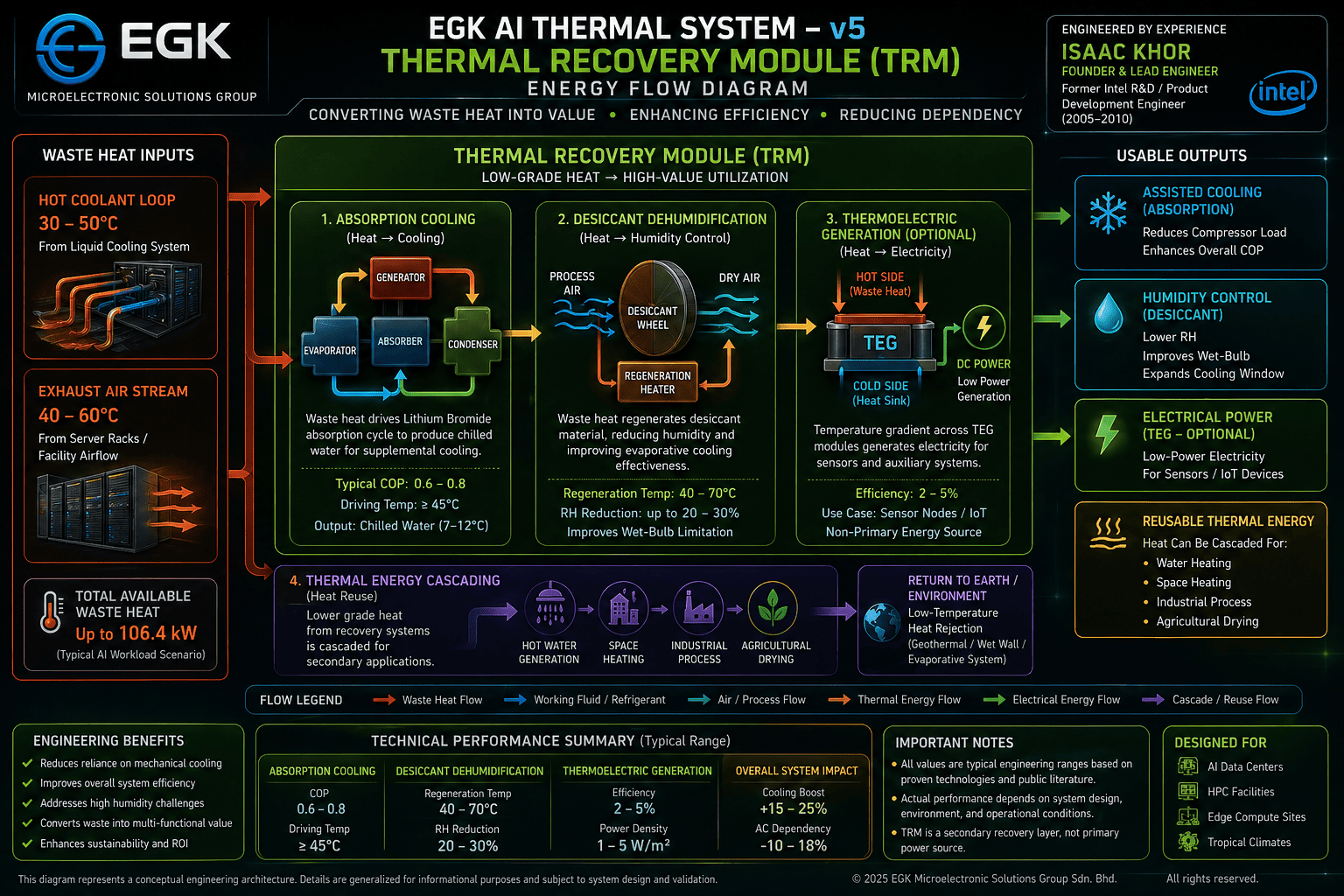
// THERMAL RECOVERY MODULE · SECONDARY ENERGY LOOP
♻️ THERMAL RECOVERY MODULE (TRM)
Secondary energy utilization layer converting low-grade waste heat into cooling,
humidity control, and auxiliary power
// SUBSYSTEM COMPONENTS
HEAT INPUTS
Sources of recoverable low-grade heat within the system,
forming the input layer for secondary energy reuse.
Coolant: 30–50°C
Exhaust: 40–60°C
Load: 106.4 kW
ABSORPTION COOLING
Waste heat drives a lithium-bromide absorption cycle to generate chilled water,
reducing dependency on compressor-based cooling.
All technical figures presented in this document are design targets derived from thermodynamic calculations, ASHRAE standards, Fourier heat diffusion models, and Malaysian Meteorological Department weather data (Butterworth Station, 2023–2024). These figures have not yet been validated through physical prototype testing or bench-level commissioning. Performance ranges are stated honestly and represent calculated estimates, not measured results. Physical prototype construction and bench validation is required before any commercial commissioning. This document and its contents are proprietary to EGK Microelectronic Solutions Group Sdn. Bhd. and are protected under the executed Non-Disclosure Agreement. Any reproduction, distribution, or disclosure to third parties without written consent from EGK constitutes a breach of the NDA and may result in legal action.
EGK
🔐 NDA-VERIFIED ACCESS ONLY
NDA PORTAL LOGIN
For authorised parties who have executed the EGK NDA.
No tailgating. Credentials are personal and non-transferable.
No credentials yet? Complete the NDA submission (Step 2) above.
EGK will issue credentials within 1–2 business days. admin@egkhor.com.my